
5. The Filament Age Paradox
(Ancient "Collars")
The Dilemma: An Inconsistent Chronology
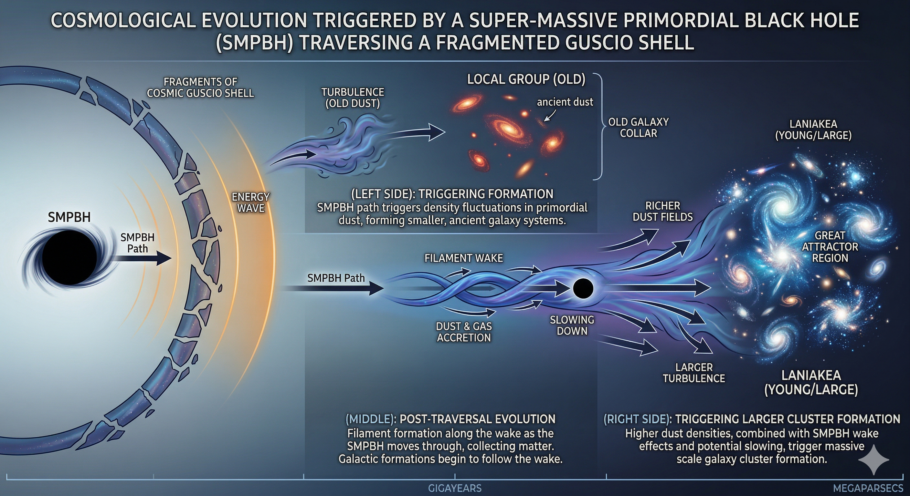
Our Local Group of galaxies is connected via a massive cosmic filament to the Laniakea Supercluster (the "Great Attractor"). However, two empirical observations defy the standard $\Lambda$-CDM model:
- The Stellar Population Paradox: Laniakea is significantly more massive than our Local Group, which should intuitively imply a longer evolutionary history. Yet, its stellar population is markedly younger.
- Axial Alignment (Polarization): There is a non-random axial polarization of galaxy spins and magnetic fields aligned precisely along the direction of the filamentary "thread" that connects our local cloud to the Great Attractor.
The Razor Suggests:
Instead of assuming a synchronized birth from an isotropic fluid, we must look at the Kinematic Genesis of the Shell. This paradox is the physical signature of a Boundary Infiltration event.
Instead of assuming a synchronized birth from an isotropic fluid, we must look at the Kinematic Genesis of the Shell. This paradox is the physical signature of a Boundary Infiltration event.
The Mother-String Narrative:
- Initial Ingress: Our primordial cold dust cloud was incorporated into our Universe during the very first millions of years.
- The Infiltration: A Super-Massive Primordial Black Hole (SMPBH) soon intruded, triggering a turbulence that formed our Local Group from this ancient dust.
- The Filament Wake: The SMPBH continued its path, leaving a "filament wake" as it slowed down.
- Laniakea Formation: Upon reaching richer, more organized dust fields, it triggered a much vast turbulence, forming the Laniakea Supercluster (the "Great Attractor"). Because the SMPBH was slower, it could aggregate much more mass, but at a later chronological stage.