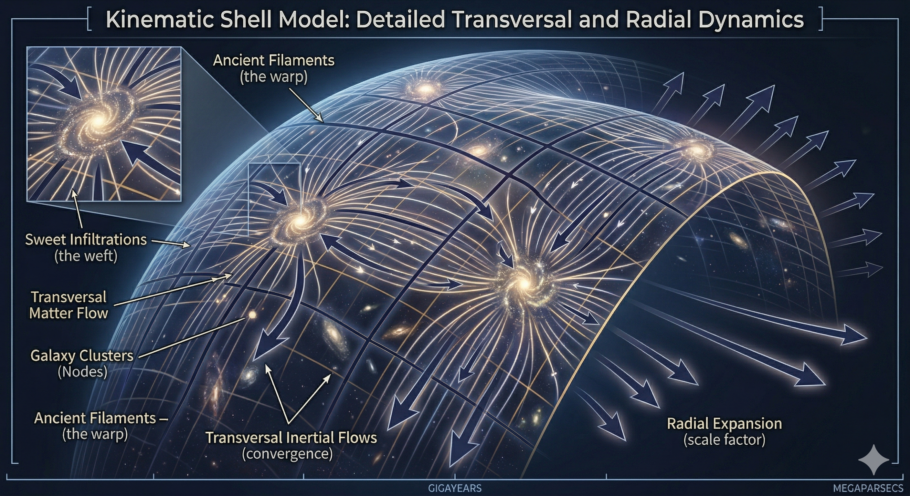

6. Transversal Equatorial Web Structure
(Sweet Infiltrations)
The Dilemma: Coherent Non-Hubble Motion
Standard cosmology assumes that galaxies should move primarily with the radial expansion of the universe (Hubble Flow). However, we observe massive "Bulk Flows"—entire sectors of the cosmic web drifting transversally toward specific attractors. These movements are too vast and too coherent to be explained by simple local gravity within an isotropic fluid.
The Razor Suggests: Equatorial Mesh Dynamics
Why invent "dark flows" or hidden masses? Ockham’s Razor suggests these are the result of the Shell’s structural stabilization. The universe is not a sphere, but a Kinematic Mesh where transversal infiltrations act as the "weft" (trama) that binds the "warp" (ordito) of the ancient filaments.
The Mother-String Narrative:
- Late-Stage Infiltrations: Because of the violent polar disentanglement (South), the Shell's equatorial region reached earlier a state of relative inertial quiet. In this phase, "sweet" (gentle) transversal infiltrations of matter and tension began to bridge the gaps between major ancient filaments.
- The Mesh Effect: These transversal flows act like cosmic "rivers" following the structural gradients of the observable Universe. They connect distant points, creating a stabilized equatorial web.
- Flow Directionality: The movements we observe toward the Great Attractor or the Shapley Supercluster are not "falls" into a gravitational pit, but more ancient inertial drifts along the internal regions. The before mentioned flows represent the later "sewing" of the cosmic structure, balancing the radial expansion with lateral cohesion.