

Assessments of Cosmic Evolution
Standard CDM frameworks, and lambda refinements, rely on the 'Ptolemaic' assumption of perfect isotropy.
However, recent high-redshift data from JWST and persistent CMB power asymmetries suggest a structural, directional gradient in the fabric of spacetime.
Modern cosmology is increasingly forced to invoke improbable stochastic coincidences to reconcile observations with present models.
We propose a more parsimonious path: applying Ockham’s Razor to transition from a centerless fluid model to a Kinematic Shell Topography. How can we assess these anomalies without multiplying dark entities? This repository offers a formal reassessment of cosmic data, moving from fine-tuned fatalities to a rational quantistic string Genesis.
Core Genesis and Cosmology
1.1 Quantistic Genesis in the Primordial Unfolding
1.2 Perspective Separation of Physical Parities
1.3 Binomial Merging: Primordial Black Holes and Clouds of Matter
1.3 Binomial Merging: Primordial Black Holes and Clouds of Matter
1.4 Asymmetric Evidence within our Event Horizon and the Hubble Tension
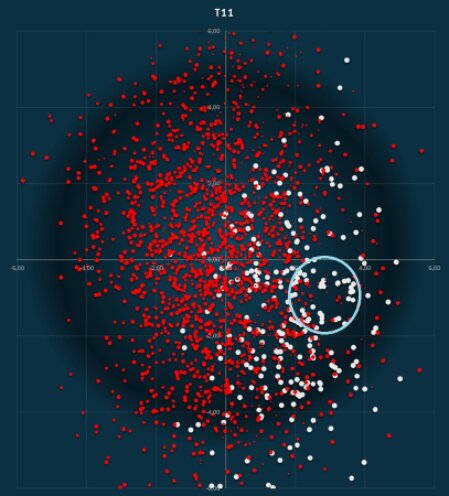
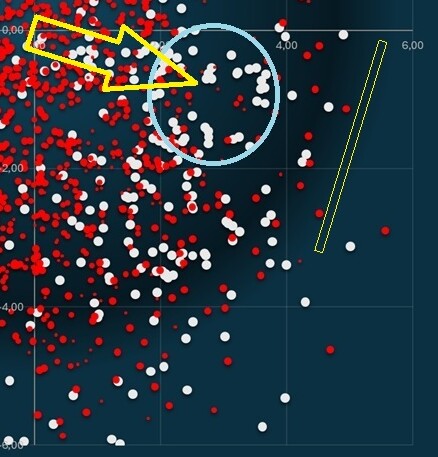
2. The Early Galaxy Paradox (JWST "Impossible" Galaxies)
- The Dilemma: Observations from JWST (e.g., J1453g) reveal massive, structurally mature galaxies at redshifts (z>10) where the Lambda-CDM predicts only primitive gas clouds.
- The razor suggests: If internal evolution lacks the necessary time, we must look to the boundary conditions. If inside is impossible, what about an outside that is infiltrating?
3. The Hemispherical Power Asymmetry (The "Axis of Evil")
- The Dilemma: The Cosmic Microwave Background shows a persistent, non-random alignment of multipoles. One half of the sky is "stronger" than the other.
- The razor suggests: This is the. Might perfect isotropy be like a "Ptolemaic" myth? How can a Kinematic Pole be produced?
4. The Bulk Flows
- Evidence of Vectorial Drift: Beyond the Hubble Tension, we observe entire sectors of the universe (Bulk Flows) drifting toward specific attractors at speeds that exceed Lambda-CDM predictions.
- The parsimony asks: may another model for the very first instants of time may explain a greater production of dark matter and explain drift effects without any dark energy?
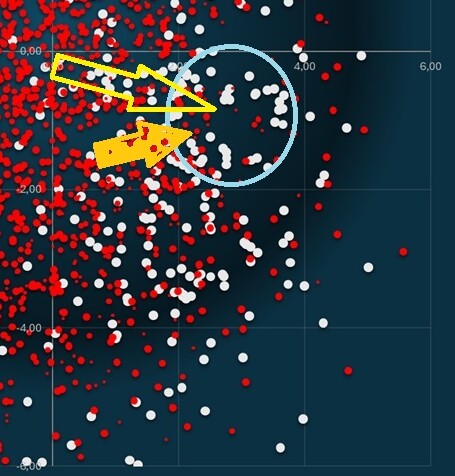
- Hypothesis: The observed acceleration is reinterpreted as a Kinematic Relaxation Phase. It is the geometric result of the mesh after the primordial merging events.
- Theoretical Framework: Standard models assume we are in a centerless fluid with unknown repulsive forces; If we are situated within a peripheral kinematic sector of a larger structure, the expansion we measure is the 'stretching' of the local mesh as it stabilizes inside a wider mesh.
5. The Filament Age Paradox
(Ancient "Collars")
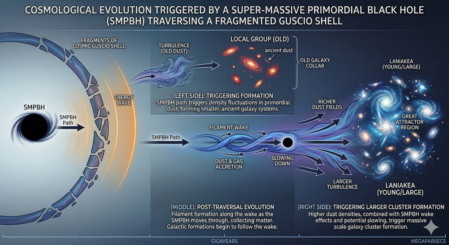
- The Dilemma: Standard models assume synchronized galaxy formation within filaments. However, we observe massive galaxy clusters connected by "cosmic bridges" despite having incompatible ages and evolutionary stages.
- The razor suggests: Why force a single birth date on a multi-phase system? These can be asynchronous accretion events. Ancient kernels act as gravitational anchors, while the younger clusters emerge from subsequent phase-resonance along the same filamentary axis.
6. Transversal Equatorial Web Structure
The Dilemma: Coherent Non-Hubble Motion
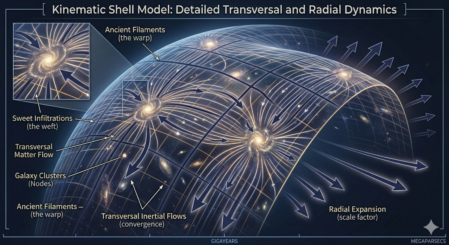
Standard cosmology assumes that galaxies should move primarily with the radial expansion of the universe (Hubble Flow). However, we observe massive "Bulk Flows"—entire sectors of the cosmic web drifting transversally toward specific attractors. These movements are too vast and too coherent to be explained by simple local gravity within an isotropic fluid.
The Razor Suggests: Equatorial Mesh Dynamics
Why invent "dark flows" or hidden masses? Ockham’s Razor suggests these are the result of the Shell’s structural stabilization. The universe is not a sphere, but a Kinematic Mesh where transversal infiltrations act as the "weft" (trama) that binds the "warp" (ordito) of the ancient filaments.
... or ... a new alternative
(presently the two papers are available only in ittalian) - (pagine che richiedono una adeguata conoscenza scientifica)
Una soluzione geometrico-dinamica alle tensioni su Ho, Lambda e l'età dell'Universo
Una sola e semplice origine capace di evolversi e rendersi visibile nel cosmo